
Are Online Earning Apps Genuine? How to Check Before You Sign Up
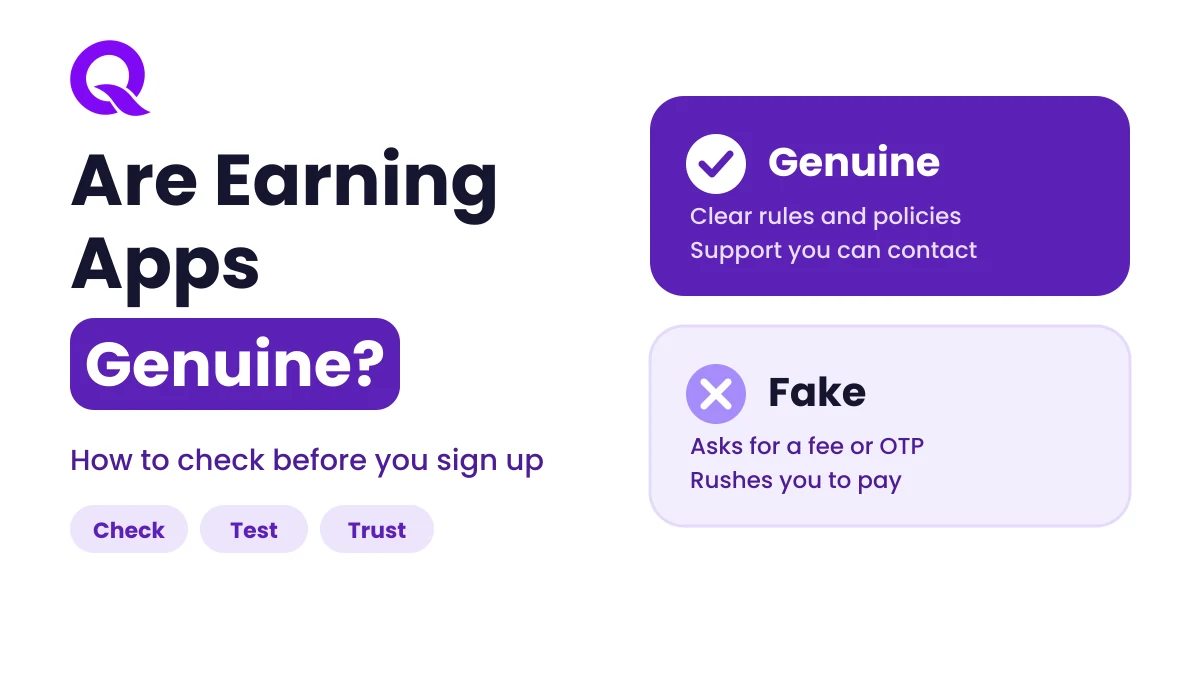
You see an ad that says "Earn ₹500 a day from your phone." It looks easy, and a friend says it worked for them. Before you install anything, one question matters more than any other. Are online earning apps genuine?
Some are. Many are not. The name of an app tells you very little. What tells you more is how it behaves before you sign up and during your first few days. This guide gives you a simple way to check, step by step.
Why This Question Matters
Online earning apps are popular because they promise easy money from a phone. Scammers know this. The Ministry of Home Affairs has said that its cyber crime unit found over 100 websites linked to organised investment and task-based part-time job frauds, and that young people looking for work are among the targets. A bank security advisory describes a similar pattern: a task that looks harmless, followed by a request for your money.
This does not mean every earning app is a scam. It means a few minutes of checking can save you a lot of trouble. If you are new to this topic, our beginner's guide to earning money online in India explains what is realistic.
Genuine vs Fake: The Quick Picture
This table gives you the short version. The steps below explain each row.
0 selectedExport selectedExport all on page (6)Deselect allSelection applies to this page only. Read-only: nothing is changed.| What to look at | Usually genuine | Warning sign | |
|---|---|---|---|
| Cost to join | Free to sign up | Asks for a joining fee or "deposit" | |
| Rules | Terms and policies you can read | No terms, or rules that change in chat | |
| Rewards | Amount shown before you start | Vague promises like "earn big" | |
| Support | A clear way to contact the team | Only a messaging-app number | |
| Withdrawal | Minimum and process explained | Asks for a "tax" or fee to release money | |
| Personal data | Name and email to sign up | Asks for UPI PIN, card details or bank OTP |
Step 1: Find Out Who Runs the App
Start with the basics. Does the website or app have an About page, a contact email, a privacy policy and terms of use? Do those pages read like real, written text? Or are they empty, copied or full of mistakes?
Then search the app name together with words like "complaint" or "problem". Read what you find with care. Reviews can be bought, and a high star rating on its own proves very little. You are looking for patterns, such as many people saying they could not withdraw.
Step 2: Read the Rules Before You Register
Most people skip this step. It is the one that helps the most. Open the terms and look for four things: the minimum age, how many accounts you can have, what counts as fake activity, and the rules for withdrawals.
If you cannot find the rules at all, that is your answer. A genuine platform is happy to show you what it expects from you. For example, the QykJob Terms of Use let anyone join, ask users under 18 to have a parent's or guardian's permission, and allow one account per person. The How It Works page says fake or repeated activity can lead to account suspension. Whichever app you check, this is the kind of detail to look for.
Step 3: Check What It Asks You to Pay
This is the clearest test. You should never have to pay to start, to unlock tasks or to withdraw your earnings. Scam apps use many names for the same request:
- Joining or registration fee
- Activation or "security" deposit
- Processing fee or "tax" to release money
- Upgrade to a VIP or premium level to earn more
If an app asks for any of these before it pays you, stop. Also never share your UPI PIN, card number, CVV or a bank OTP. A genuine earning platform has no reason to ask for them. A verification code sent to your email to confirm your account is different. That is normal, and it is not a bank OTP.
Step 4: Look at How Rewards Are Described
Real platforms are usually boring about rewards. They show an amount for each task and tell you that earnings can vary. Scam apps sound exciting. Be careful with these signs:
- Fixed daily income, such as "₹5,000 every day"
- Words like "guaranteed" or "double your money"
- Pressure to hurry, such as "only 10 spots left today"
For example, the How It Works page on QykJob says each task shows its reward before you start and that earnings are not guaranteed. That is the honest way to describe it. If you want a realistic picture of what small tasks can pay, read what is actually possible without investment. For a closer look at daily income claims, see daily earning apps: what is realistic and what is hype.
Step 5: Test With a Few Small Tasks
Do not spend your whole week on a new app. Try a few tasks first and keep simple notes: the date, the task, the reward shown and what your balance shows afterwards. Does the balance match what you were told?
Keep one thing in mind. A number on your screen is not the same as money in your bank account. Before you give an app more of your time, read its withdrawal page. Check the minimum amount, the payment method and how long the review may take. Only real money received in your own account counts as proof.
Step 6: Protect Your Personal Data
Share only what the app needs. Be careful if it asks for ID documents, photos or bank details right at sign-up, before you have done anything. Ask yourself why it needs them at that point.
- Use a strong password that you do not use anywhere else.
- Use an email address that you check regularly.
- Install apps only from the official app store, or open the website by typing its address yourself.
- Do not click links in messages from people you do not know.
If Something Feels Wrong
Stop right away. Do not pay anything more, even to "get your money back". Take screenshots of the app, the chats and any payment details. Change your password, and tell your bank if you shared any financial information.
If you have lost money, call the national cyber crime helpline 1930 as soon as you can and file a report on the National Cyber Crime Reporting Portal. Reporting early gives you the best chance of help.
A Short Checklist to Save
- It is free to join, with no fee or deposit.
- Terms, privacy policy and contact details are easy to find.
- Rewards are shown clearly and nothing is guaranteed.
- It never asks for your UPI PIN, card details or bank OTP.
- You tested it with a few tasks before investing more time.
- The withdrawal rules are explained before you start.
- You know where to report a problem.
Frequently Asked Questions
1. Are online earning apps genuine?
Some are, and some are not. There is no single rule that works for every app, which is why checking the rules, the fees and the reward details matters more than the name.
2. Can a genuine app still pay very little?
Yes. Genuine does not mean high income. Most small online tasks pay modest amounts, and the pay depends on the task and the time you give.
3. Is an app genuine if it has many downloads and good ratings?
Not by itself. Downloads and ratings can be misleading. Check how the app treats fees, rules and withdrawals instead.
4. Should I pay a small fee to get started?
No. A fee to start, to unlock tasks or to withdraw is a strong warning sign. Small fees are often how bigger demands begin.
5. What if an app says I must bring friends to earn?
Referral rewards are common and can be fine. Be careful when the only way to earn is to recruit people, or when you have to pay to invite them.
6. Where do I report a fake earning app?
Use the National Cyber Crime Reporting Portal. If money is involved, call the helpline 1930 as well.
The Bottom Line
You do not need special skills to spot a risky earning app. Check who runs it, read the rules, never pay to start, test with a few tasks and keep your personal data safe. If you want to see how a platform explains itself, you can look at the How It Works, task categories and FAQ pages on QykJob. Compare them with any other app you are thinking about.
Sources
Related articles
Micro Task Websites in India: How They Work
What micro task websites are, who pays for tasks, the main kinds, how rewards are checked and how to choose a genuine one in India.
Read article →
Small Tasks to Earn Money: Examples and What They Really Pay
Quizzes, surveys and other small online tasks explained. See the task types on QykJob, how rewards are shown first, and how to spot fake offers.
Read article →
Online Earning for Students: What Works Alongside Studies
Studies come first. See what can fit around classes, the age rule to check, and the safety habits every student needs.
Read article →